
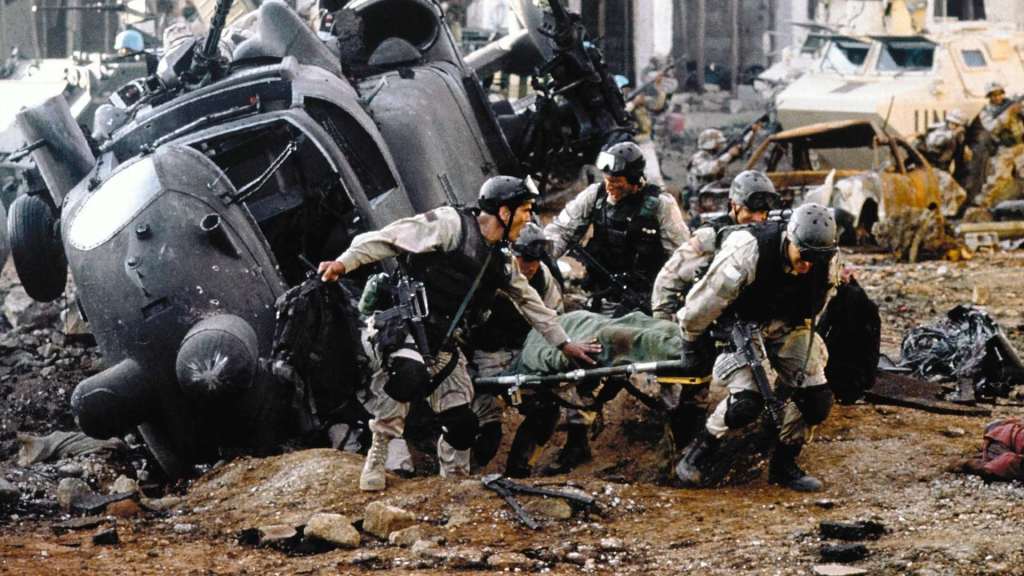

A forgotten masterpiece in the war genre.
Ridley Scott’s Black Hawk Down captures the sheer intensity, as well as the heartfelt commodity of the brave men during the battle of Mogadishu. The story follows US marines who are sent to Somalia to bring aid over to the people. Their mission was to capture the war lord, however when two of their helicopters are gunned down by Somalian’s, the mission then turns into a 16 hour long blood shredded nightmare.
By 2002, Ridley Scott was mostly known for his work in the sci fi genre. A master of pioneering large worlds with original concepts, as seen in Alien (1979) and Blade Runner (1982). He is considered a pure artist in the medium. This time around, he is aided with a cinematic icon in the action genre, Jerry Bruckheimer, who seems to always be attached to big studio productions such as Armageddon (1998) and The Rock (1996). This film separates itself from those previous films because the spectacle isn’t the films main selling point. It’s the courage of the soldiers. Having said this, all of the action sequences are incredibly well orchestrated. From the choice of camera angles, the acting and even the sound design, which is what the film won the Oscar for. However, it’s the emphasis on the soldiers on going struggle to be there for one another that seems to be the highlight of the whole picture. Jerry Bruckheimer adapted the core themes from the book written by Mark Bowden to the film, which focuses on the bravery of the men.
The soundtrack, which is composed excellently by Hans Zimmer, reinforces this theme of bravery. In particular, the score “leave no man behind” is really the essence of the film. The use of acoustic instruments during the battle sequences resemble the Mogadishu environment, creating an impossibly realistic experience. You feel every bullet that flies past these soldiers and that’s all due to the excellent work by the editor, Pietro Scalia.
The film seems to have helmed quite a production crew behind the camera. With the likes of Jerry Bruckheimer, Simon West was added as an executive producer, he would later direct the action heavy Expendables 2 (2012). However, the cast of the film is ever more impressive, with actors such as Ewan Mcgregor, Josh Hartnett, Eric Banner, Tom Sizemore and most notably Sam Shepherd who adds subtle intensity to his performance. The combination of both parties in and off the camera seems to fit very nicely. At first glance, this may seem like a B war film as there is little substance but because the technical aspects are handled so perfectly, the film gets away with having little to no substance because we pretty much know nothing about these soldiers. When we consider other films that have failed in this department, films such as Act of Valour (2012) in which the acting kept the film at a sub par quality despite its terrific action sequences and more recently Michael Bay’s 13 Hours (2016) which wasn’t bad but it contained more style than substance, resulting in Bay-hem. Both of these films are driven towards the excitement of war spectacle but don’t quite deliver in other departments such as acting and most importantly realism. Black Hawk Down strikes this tone perfectly and still manages to inject intensity in every frame.
To this day, it is one of my favorite war films. It still holds up.
 TheReviewAwakens