
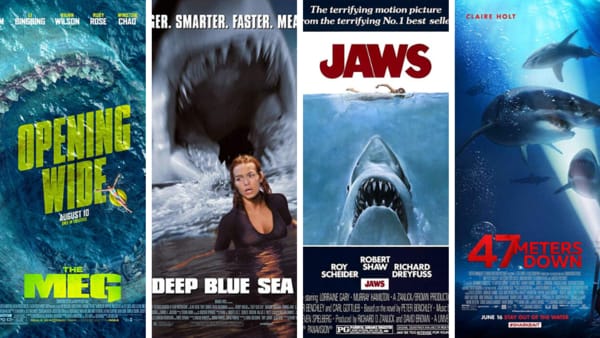
A genre that has failed to impress since 75, wow that’s a long time. In this article, we explore the possible reasons as to why the genre has never been taken seriously and why it needs to be if we were to experience something like the slice of gold that is Jaws.
Audiences have usually dismissed this quality of the genre ever since Jaws (1975) hit screens. This is thanks to the awful Sharknado franchise and countless others. It’s no secret that audiences tend to think that directors have lost the art of implementing realism into this genre and this is because the majority of shark films since 1975 haven’t been able to properly terrify audiences, in my opinion. Let’s explore the genre and how it has evolved since 1975.

I would like to place Die Hard 2 director Renny Harlin’s Deep Blue Sea as part of my central debate. I believe the film was a fairly noble attempt to make an exciting shark film, although still at B film quality. With this, I hope to understand the genre and more importantly know how to get it right through the discussion of its characters and practical effects. Jaws (1975) is not only the best shark film but it is one of the greatest films ever made with much more substance compared to the new shark movies we see today.
It works for several reasons, such as the soundtrack, the use of practical effects but most importantly I think it’s the characters that stay with you throughout the ride. It’s the three main leads that form such a complimentary trio that of Brody, Quint, and Hooper, even more so than the wolfpack from The Hangover trilogy and that’s saying something. Therefore, its success comes down to its characters and its use of practical effects. The shark was a mechanical model which was as realistic as you can get in cinematic forms. It’s that attention to detail that frightens audiences the most.
To add to this, Jaws 2 is both an unnecessary and inevitable film, yet it works when we learn of Chief Brody’s downfall as a cop because we have come to admire him from his heroic acts in the first film. It’s crucial that we can at least be invested in these characters. In modern-day cinema, several straight to DVD shark films are produced and its actually rare that we find a cinematic released shark film that’s actually good. This shows the little hope that producers have in this genre.
In that selection, we can discuss The Meg, The Shallows, The Reef and Open Water. I enjoyed The Meg and The Shallows, however, those films included a shark that was too big to be believable and heavy use of CGI which ultimately leads to a B film experience that loses the realism, which failed to grab my believability. Open Water on the other hand had a terrifying premise but was executed on a student film like budget. On the other hand, The Reef used real footage from a great white shark, which at times worked, but after a while, the terror began to fade and the film became painfully predictable, yet Jaws sustained the tension in minute 1.
This concludes that the more use of practical effects of the shark , the better. For example, in Deep Blue Sea, although there are many shots where you can tell the shark is completely CGI, we get some glorious glimpses of a practical shark. The shark is designed to look realistic. Its piercing black eyes and razor-sharp teeth give a menacing impression.
Deep Blue Sea (1999) follows a team of scientists who all aim to get rid of Alzheimer’s disease. They do this through research on Mako sharks. When several mako sharks break into the facility. Their aim shifts to survival. The cast includes Thomas Jane, Saffron Burrows, Samuel l Jackson, Stellan Skarsgard, LL Cool J, and Michael Rapaport. For the most part, this cast works well. The film’s main leads are Thomas Jane, who does his best John Mcclane impression, and Saffron Burrows who plays a cold but intelligent scientist who is the main instigator of the operation. Some of the standouts include Samuel L Jackson and LL Cool J who add humor even when he is thrown into the most terrifying scenarios. He also forms a nice friendship with his parrot and Thomas Jane, making him likable.
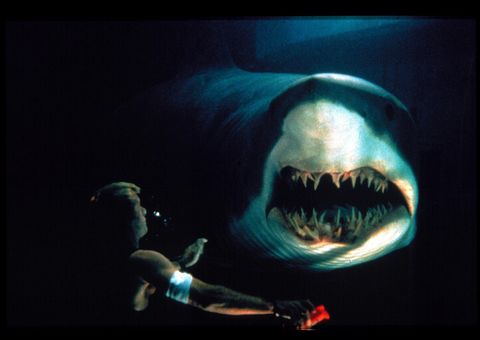
The plot itself is very B film-like, however, it does contain some interesting motivations. The plot is driven by a will to find a cure for Alzheimer’s disease, which is a theme that all audiences can get behind as it is a very real issue. It is mentioned that Saffron Burrow’s character, Dr Susan McAlester cares more about the successful implementation of this experiment over the lives of other people. She redeems herself when she sacrifices her life in the final act. In the similar vein of shark genre plots, this one is sometimes hard to believe due to some of the character’s blunderous choices but it’s exciting. It takes ideas from previous shark films but expands them on a grand scale. With this, we not only get glimpses of a practical shark but also shots of real destruction.
When the sharks break the glass, we get a wide shot with a few cuts showcasing the internal destruction. They use a real water tank which adds to the believability. Unlike several teen slashes, you feel a sense of commodity and real fear with this crew. Whenever one character dies you feel a sense of loss because they do. This results in deaths that do not feel meaningless, which is so important in this genre. This is shown when Michael Rapaport’s character dies, LL Cool J takes a moment to remember him, giving us a reason to feel invested in him.
They also find themselves in a very terrifying scenario, one that is very hard to escape from, when several mako sharks break the glass of their underwater facility, which results in flooding on almost every department and layer of the infrastructure. One moment, in particular, LL Cool J hides in an oven to escape from the shark only to find the shark turning the oven on by accident. Although this idea is Ludicrous in several ways, it is still a scary experience to visualize. John Williams’s score to Jaws was perfect, however, the score composed by Trevor Rabin does shine on a few occasions.
For a genre like this, the context is crucial. Like I mentioned earlier, there is the use of CGI in this film. However, I am a little more forgiving. 1999 was a year where Hollywood was transitioning into using computer-generated effects. At the time, they believed rightly so that these effects were ahead of its time and they were going to be a pivotal tool in immersive and expansive storytelling, but time hasn’t been too kind.
Therefore, this emphasizes how important practical effects are, especially in the monster genre as they have long-term appeal. Although, using CGI today is an unfortunate trend that several directors find themselves into usually due to low budget limitations. From this conclusion and comparisons to the recent releases of new shark movies such as The Meg and The Shallows, the long-term success of a shark film is dependent on its use of practical effects and creating a realistic premise. The shark in The Shallows seemed huge, too big to be believable. Jaws got the size of the shark just right, big enough to be intimidating but not too big to blow the film out of reality.
The Meg passed as a straightforward experience, however, Jason Statham can be a serious dramatic actor when he needs to be. He has a presence and great talent, as shown in Hummingbird (2013). The Meg could have scared me more but settled for a tone that was more humorous then it was riveting.
Although there have been several popular shark films produced since Jaws, maybe audiences will never get to see a work of art in the genre. A handful of films have come close, but I am still waiting to see a dramatic and hyper-realistic take on the most terrifying sea creature on our planet, the Great White Shark, or like video game adaptations, it might be time to give up on the genre and its potential.
Author Bio

Sam is a content writer. He loves all elements connected with film and writes with passion, always. You can find him on Linkedin, where you will be able to read more articles. When he is not writing, you can find him practicing football.



 TheReviewAwakens